
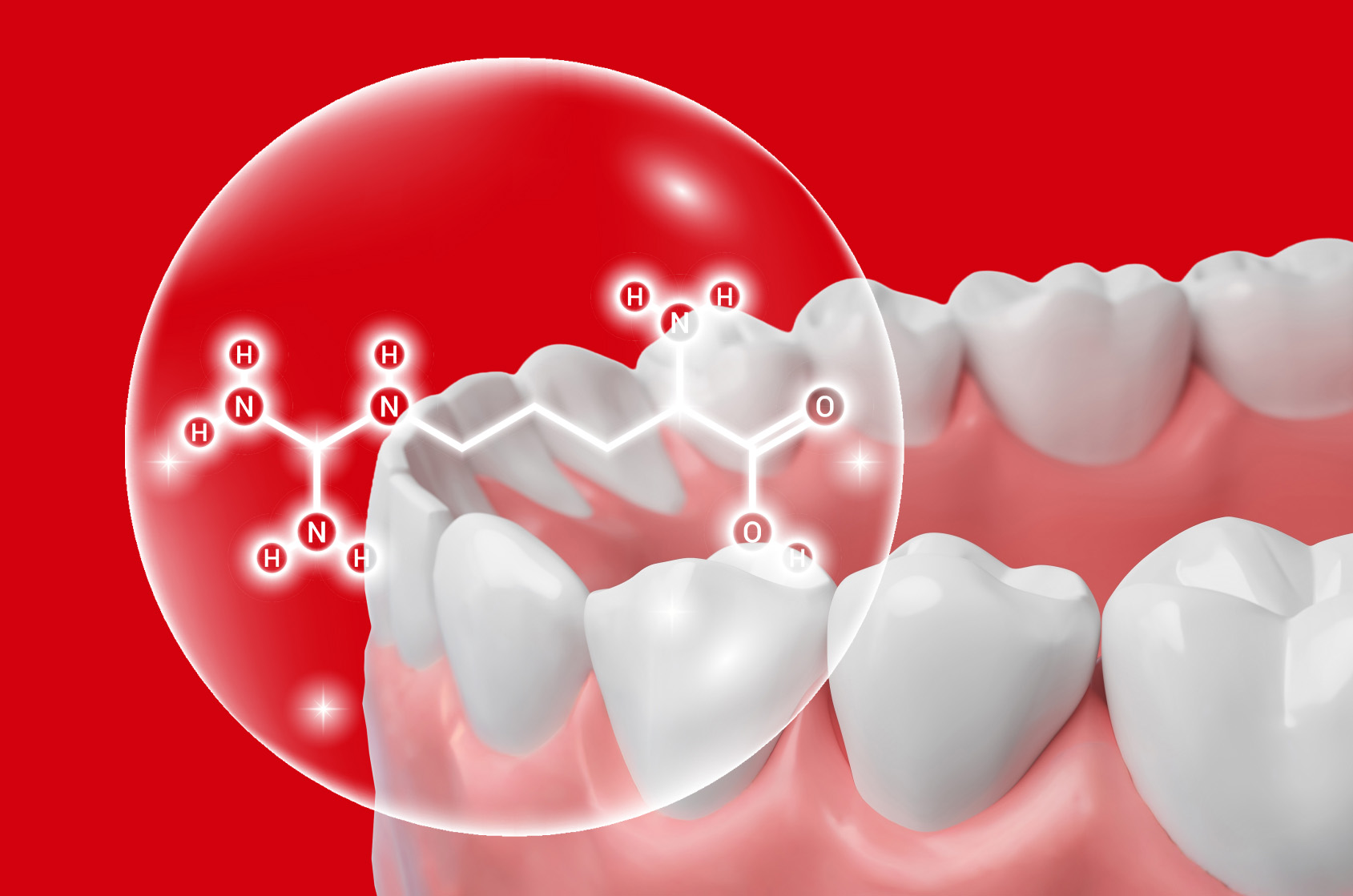
Why Does Arginine Matter in Caries Biology?
Dental caries is caused by acidification of the oral biofilm, following carbohydrate metabolism. Arginine acts as a key alkali-generating substrate in oral biofilms.
It is metabolised via the arginine deiminase system (ADS) to produce ammonia, which in turn neutralises plaque acids, elevates the pH and stabilises the biofilm. ²
How Does Arginine Work: Mechanism of Action²
Arginine is effective in caries management and prevention for the following reasons:
- It has a pH buffering effect
- Ammonia (NH₃) binds to H⁺ and raises plaque pH³
- Counteracts the acidogenic environment after sugar exposure
- Brings about ecological biofilm modulation
- Acts as a prebiotic and promotes the growth of beneficial, non-cariogenic bacteria that contain Arginine Deiminase System (ADS+ bacteria)
- These bacteria raise the pH of dental plaque, neutralising harmful acids produced by caries-causing bacteria such as Streptococcus mutans.
- Has matrix & structural effects
- Alters biofilm architecture and carbohydrate matrix composition
- Decreases biofilm virulence and acidogenic potential
Arginine & Fluoride: Synergistic Combination
Demonstrates greater caries reduction vs fluoride alone.
- Fluoride → Enhances remineralisation, inhibits demineralisation
- Arginine → Restores ecological balance & pH homeostasis
Clinical Applications of Arginine+Fluoride Dentifrice
- Arginine-containing dentifrices (≈1.5%)
- Adjunct for patients with moderate–high caries risk and showed significantly greater improvement in caries lesions at 3 months compared to nonfluoride dentifrice.⁴
- Early lesion management
- Supports reversal of white spot lesions.⁴
- Preventive protocols
- Especially useful as daily at-home care for:
- Individuals with frequent sugar exposure
- People with reduced salivary flow
- Orthodontic patients
- Reduces dental hypersensitivity ²
- Arginine-containing pastes (which have around 8% arginine) used as preprophylaxis in the dental office or at-home dentifrices have been found to be effective in reducing dentinal hypersensitivity after a single application.
The mechanism behind reduction in tooth hypersensitivity includes the physical sealing of dentinal tubules with plugs that contain arginine, calcium carbonate and phosphates (typically present in these pastes).
These dentinal plugs resist pulpal pressure changes and acid challenged, reducing dentin fluid flow, which is the primary cause of hypersensitivity.
Take-Home Message
- Higher ADS activity is seen in caries-free vs caries-active individuals5
- Arginine treatment represents a paradigm shift from antimicrobial to ecological caries management
- Focuses on biofilm modulation rather than bacterial eradication
- Strong evidence supports its role in caries prevention, risk reduction, and early intervention
Give your patients the power of Arginine with advanced protection from Colgate.
Its Dual-Zinc + Arginine formula delivers enhanced antimicrobial action for comprehensive oral protection. Here’s how Colgate Total supports effective caries management in your patients:
It reduces microbial load across key oral surfaces:
- 38.3% on teeth
- 39.7% on the tongue
- 35.4% on the cheeks
- 25.9% on the gums
Gives 24 hours of non-stop anti-germ action with the proven benefits of arginine-powered Colgate Total.*
*with 2x daily brushing, 4 weeks continued use
References:
Giacaman RA, Fernández CE, Muñoz-Sandoval C, León S, García-Manríquez N, Echeverría C, Valdés S, Castro RJ, Gambetta-Tessini K. Understanding dental caries as a non-communicable and behavioral disease: Management implications. Front Oral Health. 2022 Aug 24;3:764479. doi: 10.3389/froh.2022.764479. PMID: 36092137; PMCID: PMC9448953
Shi, J. T. D. T. W. D. P. X. H. D. P. W., PhD. (2024, April 10). The Role and Impact of Arginine on Dental Caries Therapeutics. The Journal of the American Dental Association. https://pages.ada.org/jadaplus_arginine/the-role-and-impact-of-arginine-on-dental-caries-therapeutics
Ledder, R. G., Mistry, H., Sreenivasan, P. K., Humphreys, G., & McBain, A. J. (2017). Arginine exposure decreases acidogenesis in Long-Term oral biofilm microcosms. mSphere, 2(4). https://doi.org/10.1128/msphere.00295-17
Marwah, N., Asokan, S., Puranik, M. P., Nuvvula, S., Suprabha, B. S., Wadgave, U., Goyal, V., Kakanur, M., Damle, S., Sreenivasan, P., Shyam, S., & Thakur, D. (2023b). Arginine: a new paradigm in preventive oral care. International Journal of Clinical Pediatric Dentistry, 16(5), 698–706. https://doi.org/10.5005/jp-journals-10005-2693
Nascimento, M. M. (2019). Approaches to modulate Biofilm ecology. Dental Clinics of North America, 63(4), 581–594. https://doi.org/10.1016/j.cden.2019.07.002
Join us
Get resources, products and helpful information to give your patients a healthier future.
Join us
Get resources, products and helpful information to give your patients a healthier future.
