
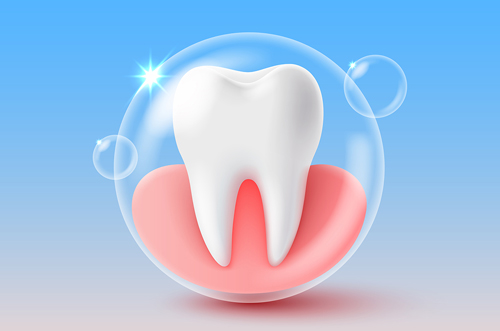
What is Guided Bone Regeneration?
Guided bone regeneration (GBR) is a surgical procedure that uses bone grafts with barrier membranes to reconstruct minor defects around dental implants. It is usually advised when dehiscence or fenestration defects around implants are ≥2 mm. 1
The bone replacement materials in GBR are used as a scaffold to provide a stable foundation for bone regeneration around an implant.
Wang and Boyapati suggested the PASS principle (P: Primary closure, A: Angiogenesis, S: Space maintenance, S; Stability) for the success of GBRs.
When is Guided Bone Regeneration Indicated?
Guided bone regeneration is typically recommended in the following clinical scenarios:
- When the bone defect is greater than 2mm
- If there is low bone volume around a planned implant site
- In case of severe gum disease when bone loss has occurred
- To restore bone structure after facial injuries or trauma
- Following tooth extraction, especially in the posterior regions of the jaw, to preserve bone for future dental implants
Ideal Characteristics of GBR Membrane Material²
Here are a few characteristics that membranes utilised in guided bone regeneration must have:
- Biocompatibility
- Cell-occlusion properties
- Integration by host tissue
- Clinical manageability
- Space-making ability
- Adequate mechanical and physical properties
Different Membranes Used for GBR
| Type of Membrane | Advantages |
|---|---|
Synthetic Polymers
|
|
Natural polymers
|
|
|
|
|
|
The Step-by-Step Process of GBR
This is how a guided bone regeneration is done:
Step #1: Preparing the site
The alveolar socket and gum margins are thoroughly cleaned. Any infected tissue is cleaned and the site is disinfected and sterilised. Choose the bone graft type and membrane you wish to use for the procedure.
Step #2: Membrane placement
Bioresorbable membranes are placed between the gum tissue and bone to create a barrier.
Step #3: Placement of bone graft
Bone grafts are placed into the socket and the gum pocket to enable the membranes to help tissues grow into the desired shape and direction.
Step #4: Site closure
The site is closed using incisions. Place tension-free sutures to enable healthy healing.
Healing and Post-Operative Care
- Once the graft is placed, the body forms a blood clot within the graft, which then releases growth hormones to help in healing.
- In a few days, the clot is absorbed by the body and replaced by granulation tissue, establishing a healthy blood supply.
- This creates a healthy foundation for the patient to receive an implant in the socket.
The entire process of regeneration takes around four months. However, most surgeons prefer a minimum of six months of healing and sometimes even nine months for cases with larger defects. 1
Complications of GBR
The two most common complications that you may encounter with guided bone regeneration procedure include membrane exposure and wound dehiscence. 1
- Membrane exposure
- Causes:
- Wrong or inadequate flap design
- Soft tissue tension
- Excessive graft material
- Trauma due to temporary denture
- Mastication
- Wrong or aggressive tooth brushing
- Causes:
- Dehiscence of the wound
- Causes:
- Pre-existing dehiscence defect around the upper part of an implant
- Bone graft substitute moves towards the implant apex
- Causes:
How to Achieve Successful Outcomes of Guided Tissue Regeneration?
Here are a few tips and best practices for successful outcomes:
- Proper case selection and accurate evaluation of bone defects
- Ensuring excellent blood supply to the site
- Tension-free primary wound closure
- Stable membrane fixation
- Allow ample healing period
- Mixing with autogenous bone can shorten healing period and enhance new bone quality
- Surgeon’s expertise and experience
- In the case of large defects, it is safe to perform guided bone regeneration first and place the implant later
- Prevent infection. If an infection occurs, early treatment with incision and drainage with antibiotics is done .1
Colgate’s PerioGard Range
Studies have shown regimen approach to be superior to single-drug therapies. PerioGard Regimen Therapy leverages this to deliver optimal clinical outcomes
- This tailored approach for superior gum care comprises of three components:
- PerioGard Mouthwash
- The low-staining chlorhexidine formula of this mouthwash has shown to clinically improve oral health by:
- Reducing plaque index by up to 60.9%
- Reducing gingival index by up to 45.8%
- Improving bleeding sites by up to 52.2%
- Consistent use has shown to significantly reduce plaque, gingival severity and bleeding sites, which may help enhance healing after procedures like guided bone regeneration.
- The low-staining chlorhexidine formula of this mouthwash has shown to clinically improve oral health by:
- PerioGard Toothpaste
- Powered by 2% zinc citrate, this toothpaste delivers targeted antibacterial protection for a healthier, fresher smile.
- It has shown to reduce common periodontal pathogens
- It minimises gingival inflammation and bleeding
- It offers long-term gingival health benefits with sustained antibacterial protection
- PerioGard Toothbrush
- Powered by groundbreaking Anchor Free Tufting Technology (AFT), the PerioGard Toothbrush delivers superior cleaning for healthier gums:
- The 6000+ multi-height, ultra-soft bristles ensure access to gumline
- The toothbrush offers precision cleaning to hard-to-reach areas
- Powered by groundbreaking Anchor Free Tufting Technology (AFT), the PerioGard Toothbrush delivers superior cleaning for healthier gums:
- PerioGard Mouthwash
References:
- Kim, Y., & Ku, J. (2020). Guided bone regeneration. Journal of the Korean Association of Oral and Maxillofacial Surgeons, 46(5), 361–366. https://doi.org/10.5125/jkaoms.2020.46.5.361
- Elgali, I., Omar, O., Dahlin, C., & Thomsen, P. (2017). Guided bone regeneration: materials and biological mechanisms revisited. European Journal of Oral Sciences, 125(5), 315–337. https://doi.org/10.1111/eos.12364
Join us
Get resources, products and helpful information to give your patients a healthier future.
Join us
Get resources, products and helpful information to give your patients a healthier future.
